Nor the Years Condemn
Conscientious Objectors in Honley
This is an Excerpt taken from Honley in the Great War by Peter Marshall, published by Honley Civic Society
When the Military Service Act of 1916 introduced compulsory conscription to Great Britain several Honley men declared that they would rather go to jail than compromise their beliefs by supporting a war. Some, such as Quakers, objected on religious grounds, whilst others were opposed on political grounds.
Although conscientious objection was not specifically defined in the 1916 Act, the government recognised those whose ‘objection genuinely rests on religious or moral convictions’. Objectors to military service had first to apply to a local tribunal for exemption. In order to cope with the likely increase in appellants in February 1916, membership of the Honley Tribunal was strengthened to seven, adding George Sheard and G H Barraclough to the existing five who were all local councillors – Elon Crowther, George T Oldham, Samuel Jagger, G Pearson and John Edward Heap.
If a request for exemption was refused, applicants had the right to be heard by an appeal tribunal. If they were still denied exemption and refused to withdraw their objections and report for military service, they were liable to be arrested and imprisoned in either
a military or civilian jail, such as Durham or Dartmoor. Those who had their request upheld were asked to train with local volunteers or serve in non-combatant positions including such dangerous posts as front-line stretcher bearers. Public shame could be directed towards them, including being sent or presented with a white feather.
When four conscientious objectors (or war resisters) appeared before a sitting of the Honley Tribunal they were interrogated about their beliefs, particularly how they could remain in jobs which contributed to the war effort. One weaver replied that he even objected to weaving khaki cloth and a second, a yarn room assistant, stated, “When it is a question of the military machine, if there were no other means of existence than by joining the army, I should be a pauper first”.
A British Socialist Party member who worked as a twister-in said his organisation had always been opposed to warfare and he asked the clerk to the tribunal, who was his former Sunday school teacher, to confirm that he had long held such beliefs. Only his trade union had saved him from the sack for not joining up already.
Another applicant refused to answer hypothetical questions but quoted the Socialist Sunday School’s ninth precept, Do not think that he who loves his own country must hate and despise other nations, or wish for war, which is a remnant of barbarism. Concluding the hearing, the military representative on the tribunal described the conscientious objectors as ‘a great evil, hindering recruiting tremendously’ .
Arthur Shaw of Honley, a quarry foreman, was already in his mid-30s when he appeared at the Huddersfield appeal tribunal, where his appeal was rejected. He repeated the Socialist Sunday School (SSS) precept number nine and asserted that he had no intention of going to join the colours until the police came.
A yarn room assistant, Francis Henry Sowerby, member of the Honley Socialist Club, the Independent Labour Party, the No Conscription Fellowship and the Wesleyan Reform Sunday School, on losing his appeal turned to the public gallery and said “I can assure everyone here that (I) will not give way even if it means death on principle.” When arrested he quoted Robert Burns to the magistrates, “Man’s inhumanity to man, makes countless thousands mourn”. Francis Sowerby later became an Urban District councillor and chairman of the council, living at Upper Fold in Honley.
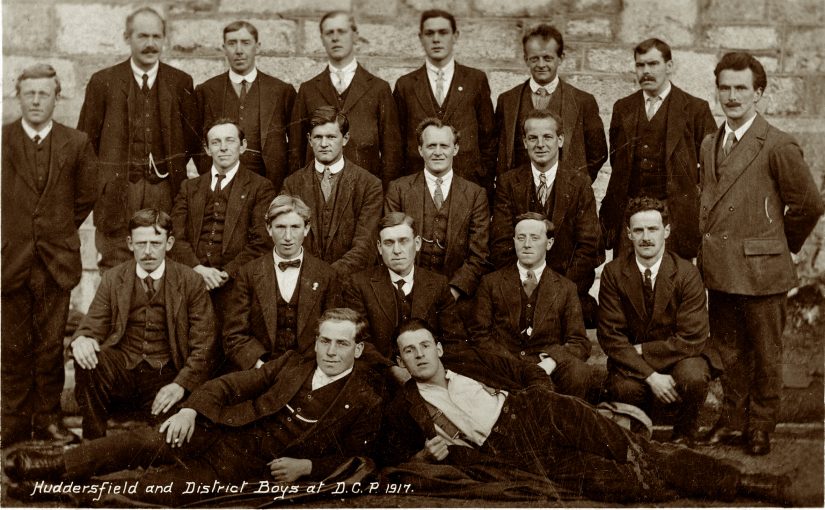
Another SSS member, 28-year-old weaver Beaumont Sykes (pictured right in 1916), continued to refuse to report to the colours until the police came for him. The usual fine of 40 shillings was imposed to be deducted from his military pay. Beaumont Sykes ended up in Dartmoor jail along with fellow club member Arthur Hirst. At his tribunal, Arthur Hirst ‘denied the right of any man or set of men to say to him that he should take the life of any man.’ When Fred Swallow, 32, was told he was fined 40 shillings to be deducted, he replied, “I don’t intend having any military pay”.
In September 1916, the Honley tribunal expressed concern that 48 local men exempted from military service were not fulfilling the condition that they had to drill with the local volunteers. However, by November 1916, further exemptions were being granted this time to employees of the Urban District Council and workers at Eastwood’s Thirstin Mill.
On 13th March, 1917, the government had reopened the jail at Dartmoor, originally built for Napoleonic prisoners, and renamed it Princetown Work Centre. By November 1917, there were 1,200 men there. The work was reported to be worse than futile, but was intentionally as hard as that at the Western Front. Out of date implements were used for agricultural work of no real value and roads were built “from nowhere to nowhere”. On his return to Honley, Beaumont Sykes lived in a one-decker cottage in Burhouse Street.
Less outright opposition to the war was also expressed. Some claimed exemption on non-conscientious grounds such as family commitments, health or an essential occupation. Some, like Honley’s first conscript, 20- year-old Norris Goldthorpe, a teazer at Rock Mill, simply failed to report on receiving his papers. When the local policeman turned up at Rock Mill to arrest him, he claimed he thought that his employer had applied for his exemption. His father said he would have sought Norris’ exemption on the grounds he was needed on the farm if he had realised this was not the case.
Mark Brooke was a cloth finisher and member of the Honley Naturalists Society but not called up until 15th July, 1918. He was against the war on political grounds and he was sent to Wormwood Scrubs, before transferring to the Army Reserve and work at a shale mine in Scotland.
In 1921 the Ministry of Health decided that all papers relating to individual cases of exemption from National Service and tribunal minute books (except those of the Central Tribunal), should be destroyed, although this was not uniformly carried out. Thus the vast majority of files do not survive, but there were certainly many men in Honley with little enthusiasm for the war, if not actively opposed to it. It might also be noted that the community tolerated the moral stance taken by these men.


