Voluntary Aid Detachment
The Voluntary Aid Detachment (VAD) was a voluntary organisation providing field nursing services, mainly in hospitals or ambulance drivers and cooks.
This is an Excerpt taken from Honley in the Great War by Peter Marshall, published by Honley Civic Society.
The majority of VADs, as the volunteers were called, worked in Britain although some were posted overseas with the British Expeditionary Force (BEF) in France during the Great War.
The organisation was founded in 1909 with the help of the Red Cross and the Order of St. John. By the summer of 1914 there were over 2,500 Voluntary Aid Detachments in Britain. Two-thirds were women and girls. Each individual volunteer was called a detachment, or simply a VAD.
At the outbreak of the Great War, VADs offered their services to the war effort. Some went to France to drive ambulances with the wounded from the battlefield, while others remained in Britain to tend to the returning injured soldiers and sailors.
The British Red Cross was reluctant to allow civilian women a role in overseas hospitals. Most VADs were of the middle and upper classes and unaccustomed to hardship and traditional hospital discipline. Military authorities would not accept VADs at the front line.
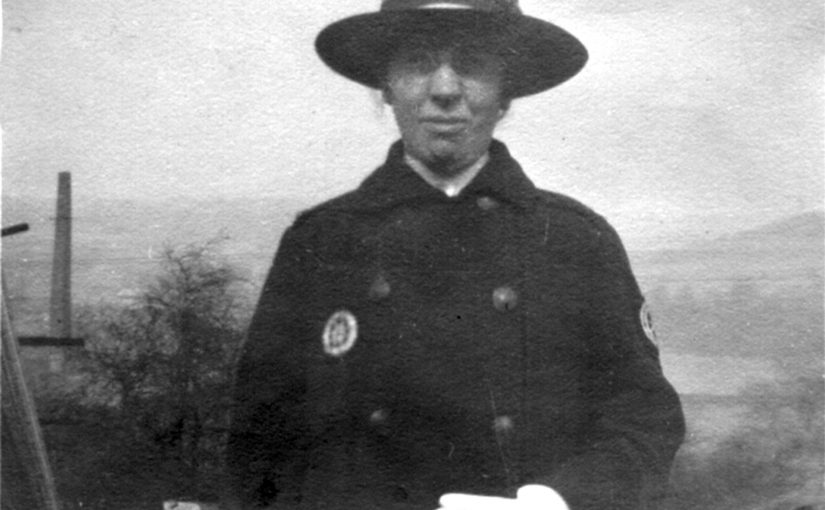
There were several VADs in Honley but the VAD we know most about in Honley was Miss Ellen (Nellie) Holdroyd. She was 35 years old in 1914, the daughter of Harold and Sadie Holdroyd and brother of Harry, later a councillor in Honley.
Nellie volunteered at the Honley Auxiliary Hospital at Moorbottom along with several other Honley women and girls. The photograph shows Nellie in VAD uniform outside her home at Far Banks. She can also be seen at the hospital in the second back row of the main photograph on page 16.


