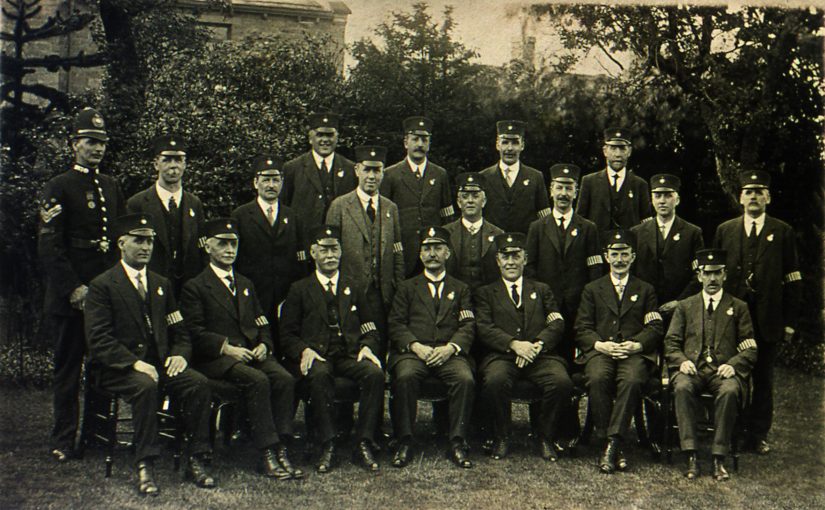
Volunteering Training Force
This is an Excerpt taken from Honley in the Great War by Peter Marshall, published by Honley Civic Society.
The Volunteer movement of 1914-1919 seems to have appeared spontaneously, mainly from the action taken by ex-officers and members of the old Volunteer Force in forming Volunteer Training Corps, entirely self-supporting and not recognised by the War Office. Units had to be financially self-supporting and members had to provide their own uniforms, which could not be khaki; the recommended colour was lovat green.
All members were required to wear a red arm band or brassard, bearing the letters “GR” for Georgius Rex. No weapons or equipment were provided, although local Territorial Army Associations were asked to supply a few dummy rifles intended for drill purposes. Membership of the Corps was only open to those who had genuine reasons for not enlisting in the regular armed forces.
The Volunteer Training Battalions became Volunteer Regiments in July 1915. In August 1916, the War Office decided to include them into the County Infantry Regiment system and they became numbered “Volunteer” battalions of their local regiment.
The Huddersfield and District Volunteer Corps No.13 (Honley) Platoon appears from the photograph (top right) to be made up of men of all ages, from smooth faced young men to bearded veterans. Without a weapon in sight, they appear to be relying on music to keep the enemy at bay. They are pictured outside Northgate House, at that time the home of George T Oldham, the Company Commander.
However, they did train for warfare. In March 1916, the Honley Platoon held a return shooting match against the Holmfirth Platoon at Moll Springs Rifle range. Each side had 13 men and each man fired ten rounds. The Honley men won the competition for the second time by the narrow margin of 1143 points to 1104.
But relaxation was also possible, for it was reported on 22nd May, 1915 that
The Drum and Bugle Band of the Volunteers (bottom right) is almost certainly made up of young men, some of them below the age of military service. It is believed that the picture was taken in the garden of Springfield House at Far End, home at that time of Arnold Sugden.


